

Human Reproduction as Prisoner's Dilemma
Slouching Towards Africa

The Dilemma
The core problem marriage exists to solve is this: it takes almost twenty years and an enormous amount of work and resources to raise children.
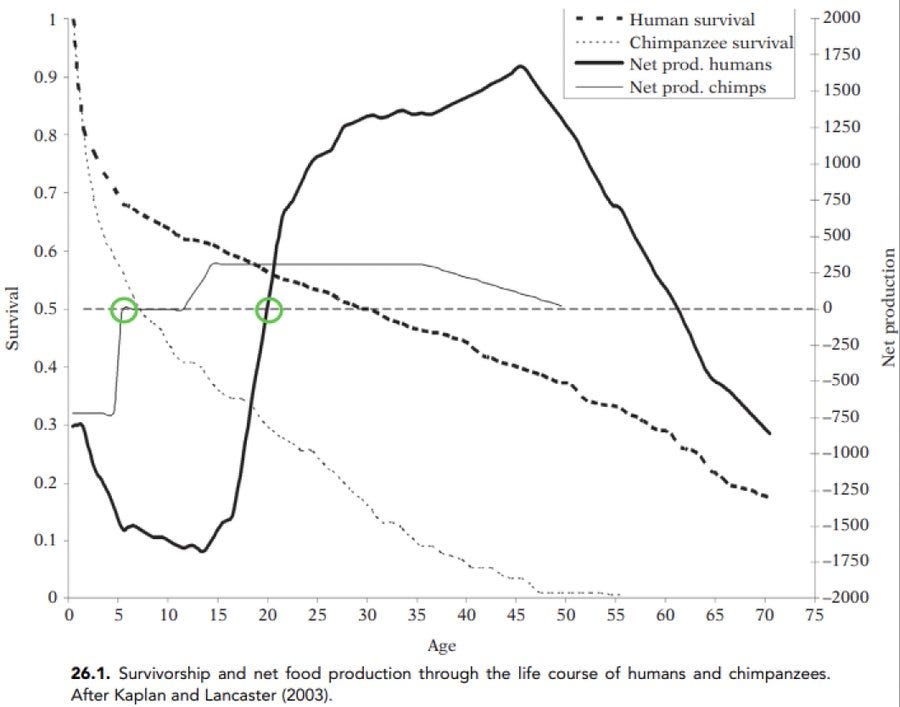
This makes human reproduction analogous to a single-shot Prisoner’s Dilemma. Both father and mother can choose to fully commit or pursue other options. Marriage provides a framework for encouraging, legitimizing, and stabilizing commitment1.
Defection
If human reproduction is like a Prisoner’s Dilemma, what does defection look like?
A natural consequence of sexual reproduction is adversarial reproductive strategies. Females must expend significant biological resources and can be certain of maternity, which allows maternal investment to pay off after birth. Males, on the other hand, don’t need to spend much biologically, but can’t be certain of paternity2, making paternal investment intrinsically risky. By default, this leads to two idealized strategies that maximize the benefits for each sex. In humans, the idealized male strategy is as many wives/exclusive sex partners as he can afford3 (once he hits the limit, replacing wives with more desirable ones if possible) plus opportunistic extra-pair couplings, consensual or otherwise. The idealized female strategy is securing investment from a man, but retaining the option to trade up for a more attractive4 man at any time, with opportunistic hidden extra-pair couplings with attractive men.
Both of these strategies greatly damage the interests of the opposite sex. Cuckoldry is next to death for a man from a Darwinian perspective, and in evolutionary environments requiring paternal investment, so is abandonment for a woman. For both sexes, losing years or decades of youth and all of the resources invested in a pairing is devastating.
Defect/Cooperate
A defect/cooperate society, in which men act to secure the collective interests of their sex without regard for those of women, looks like Meiji Japan (monogamous) or early 20th century Arabia (polygamous). In these societies, women are effectively property. Divorce is common (Meiji Japan had the highest divorce rate of any country with records in the world) and devastating to women, who lose their children, economic status, virginity, and youth.

However, a simple comparison of divorce rates between different marriage regimes is misleading. Since divorce is at the whim of the husband in defect/cooperate societies, men are free to invest in their family and children, unlike those in which men can lose their families against their will. Furthermore, paternal certainty in defect/cooperate societies is guaranteed, and as such they can be highly functional, especially combined with monogamy5 to reduce male intrasexual competition. Meiji Japan was phenomenally successful economically, demographically, and territorially until destroyed by overwhelming outside force.
Defect/Defect
A defect/defect society looks like the most primitive parts of sub-Saharan Africa or Amazonian horticulturalists. Women sleep around, while adult men prey on women and children and regularly kill each other for access to women. As men can have multiple wives and wives are not loyal, there is no respite from intrasexual competition; you can always be replaced.
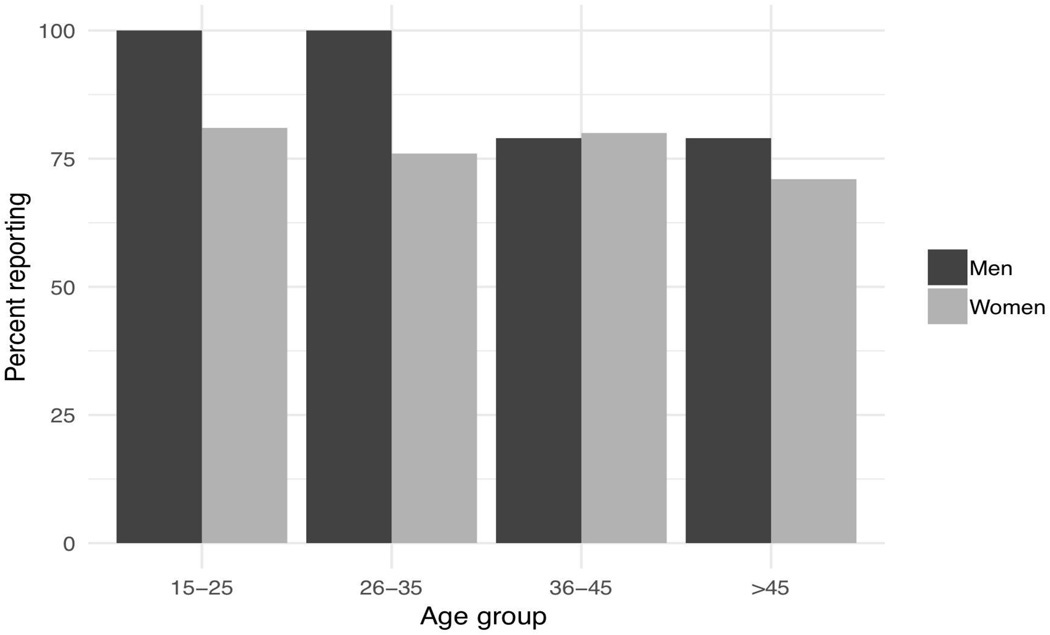
Without paternal certainty, men have no investment in the future and spend their time fighting, dancing, or resting rather than working. Economically, these societies are desperately poor and largely incapable of collective action. In war, they shatter like glass when faced with ones that expect chastity and fidelity of women.

Cooperate/Cooperate: The Western Solution
The Western solution6 to this problem can be summarized as follows:
Monogamy.
Polygamy is a natural attractor state for humans, since it satisfies the desires of powerful men to have multiple wives and those of women for elite husbands. Monogamy requires both elite men and many women sacrifice these desires. In exchange, there are severe checks on negative-sum intrasexual competition. Powerful married men are not constantly on the lookout for another wife and can devote their efforts to other pursuits, while less powerful men, who would be shut out of marriage in a polygamous society, have fewer evolutionary incentives to stab their compatriots in the back. The result is much more cohesive and powerful societies. But it’s not just male coordination that benefits from monogamy. Per Joseph Henrich (2020):
Because of how monogamous marriage influences social dynamics and cultural evolution, inhibiting female choice—by prohibiting women from freely choosing to marry men who are already married—results in both women and children doing better in the long run (on average). This occurs because of how the social dynamics unleashed by polygyny influence household formation, men’s psychology, and husbands’ willingness to invest in their wives and children.
Rather than invest in additional wives, men in monogamous societies invest in their original wife and children, with the result that almost everyone involved is better off.
Marriage by mutual consent.
This comes from Catholic doctrine (“What therefore God hath joined together, let not man put asunder”) and particularly benefits women, who cannot be forcibly married against their will.
High standards of premarital chastity (especially for women) and fidelity.
This ensures two things. First (and most importantly) paternal certainty and minimization of sexual jealousy. Second, it makes marriage the gateway to sex, which strongly encourages young people to get themselves into the long-term pair bond that is the ideal environment to have and raise children.
Divorce is difficult. The marriage contract can be created by mutual consent, but cannot be unilaterally dissolved.
This allows for greater specialization of labor within the household and greater investment in “relationship capital,” including children. It also shifts the balance of power within relationships to the more committed partner.
Men materially support their wives and children.
Men are not expected to provide for children that are not theirs, nor are they expected to provide for children born outside of wedlock. If men do not have access to their children, they are not expected to support them unless they are personally at fault.
This should be seen as a contract between the prospective husband and wife7. Like any reasonable contract, both parties are giving something up and getting something in return.
Breaking the Bargain
Pillars one and two of this solution remain. Western countries are still formally monogamous (though without any broad religious or philosophical justification, this may change. Popular support for legalizing polygamy has surged in the 21st century US) and marriage is still by mutual consent. But pillars 3-5 were systematically demolished in the mid-20th century, mostly between 1960 and 1980.
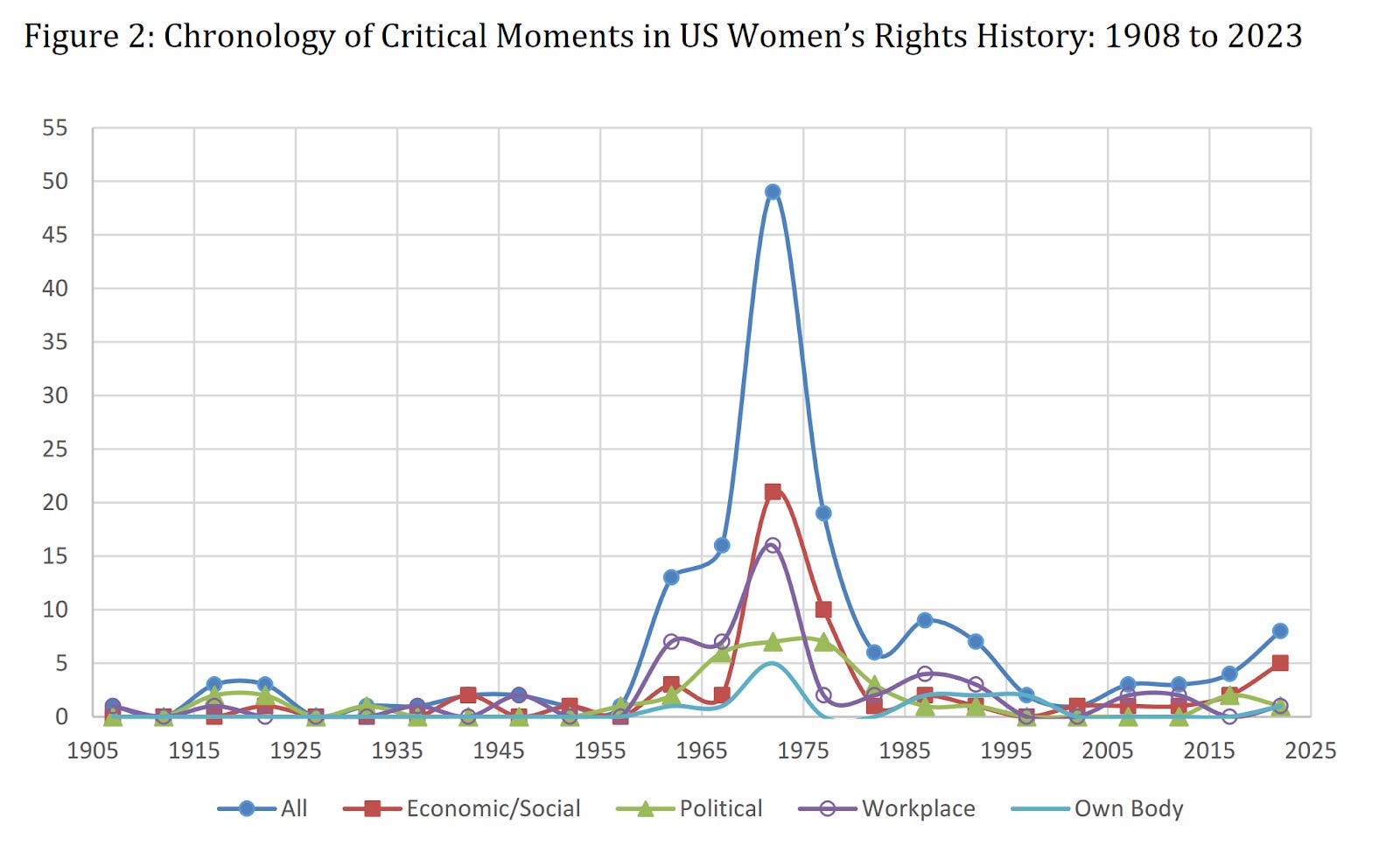
This is a chronology of laws because laws are highly legible. But what matters is people’s behavior. Not only are sufficiently strong social norms are indistinguishable from laws, but laws are interpreted by judges, and legal practice may change dramatically without any significant alteration in official statutes.
Sexual Revolution
There no longer exists any expectation of chastity until marriage. But within marriage, there’s still the expectation of fidelity, though without any enforcement mechanism beyond social stigma. This reverses the sexual incentive to marry. Rather than a gateway to sexual opportunity, marriage has become a chain restricting it.
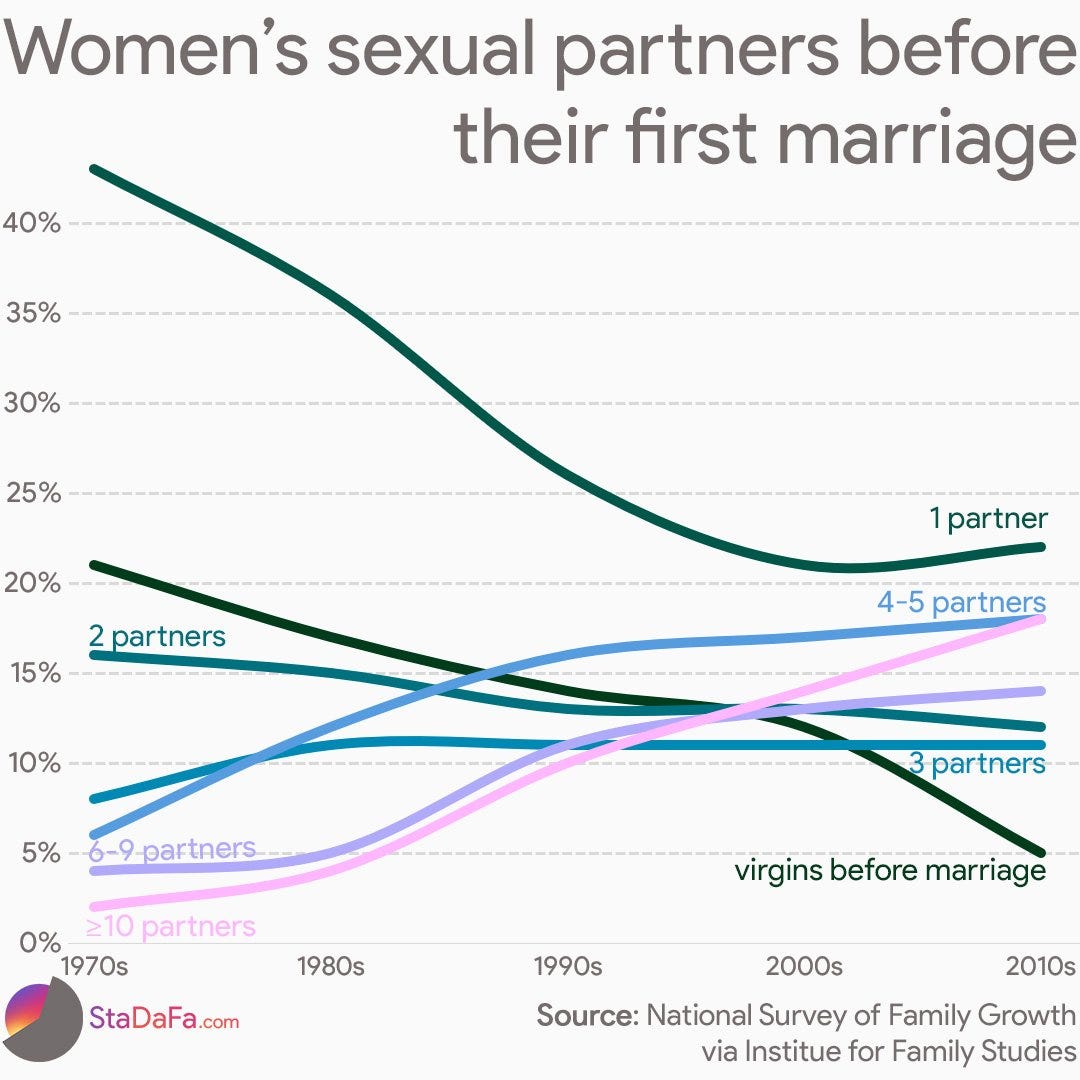
Whereas the pre-70s dispensation aligned sex drives with the pair bonding desired for raising children, the present one sets them in conflict with each other.
Unilateral Divorce
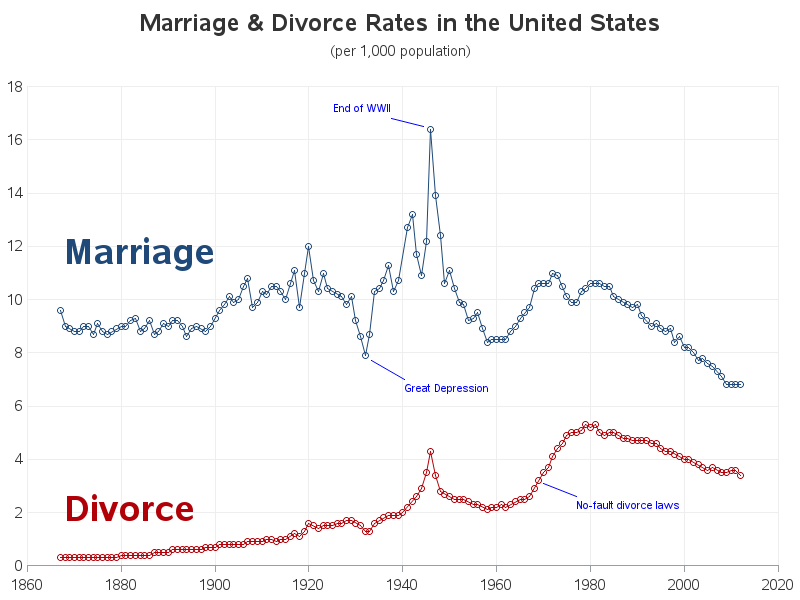
The most obvious effect of unilateral divorce is increasing the amount of divorces.

It’s worth considering what this actually means. Each divorce represents years of effort and investment wasted, and often perpetual and unwanted obligations. It often means broken families and the misery that accompanies that. In the United States, only 52% of first marriages survive the 20 years required to raise children.

But unilateral divorce doesn’t just destabilize marriage; it also changes the power dynamics within marriage from favoring the more committed partner to the less committed partner. Hence, “under unilateral divorce, the distribution of resources within marriage favors the spouse who wished to divorce” (Reynoso 2024). Furthermore, no-fault divorce in particular also incentivizes poor behavior within it, since the threat of ending the marriage on unfavorable terms for the bad actor no longer exists, which “weakens the bargaining power of dutiful partners who wish their marriage to continue or who wish to end their marriage because of serious mistreatment by the other partner” (Rowthorn 1999).
Unilateral divorce is sometimes portrayed as an advance in human freedom, but this is a mistake. By removing the ability to credibly commit to a long-term relationship, unilateral divorce removes the ability to make a mutually-beneficial bargain that greatly helps in raising children. In the absence of forced marriage (which has never been part of the Western solution), unilateral divorce removes an important choice rather than add it. In the words of Robert Rowthorn (1999):
To get married is no longer such a major commitment and no longer offers the degree of security which it once did, since divorce is now relatively easy and the responsibilities and rights of the married and the unmarried are increasingly similar. These developments are often presented as an advance in human freedom since they allow individuals to exit unilaterally from unhappy relationships at minimum cost to themselves and with minimum delay. However, this is a one-sided view, since it ignores the benefits and freedoms associated with trust and security. The fact that individuals can now exit easily, and unilaterally, from a relationship makes it difficult for couples to make credible commitments to each other. They can promise anything they want, but most of these promises are no longer legally enforceable, and many are undermined by social policies which reward those who break their promises.
Because it no longer guarantees security (or anything else), marriage is much less useful (leading to immediate lower marital fertility) and therefore much less appealing (leading to less marriage, especially in the long run).
The Welfare State
Given that women will do most childrearing and that men are more productive, most societies will involve some sort of resource transfer from men to women. As with all redistribution, this carries the obvious risk of punishing work. Marriage fixes this; a man provides for his wife and children, who he has some legal and social claim on and a built-in genetic interest in. The welfare state changes this.

Rather than a man supporting his own wife and children, he’s expected to support women with whom he has no relation with and no claim on anything in return. This is much less motivating, and also removes a major incentive for women to marry by reducing the material benefits of doing so, as the state can simply extract a potential husband’s wealth and give it to her for nothing, no marriage required. In the long run, this is bad for women too; even if they can raise children alone with state support, very few women want to do this, and by making marriage less attractive the welfare state misaligns the short-term financial incentives of young women with their long-term social incentives as potential mothers.
Summary
If the Western European Marriage Pattern represented a cooperate/cooperate solution to the prisoner’s dilemma of reproduction, the current dispensation represents an attempt to force a cooperate/defect equilibrium on men. Men are expected to spend their lives working for women and children that are not their own. They can be ejected from a marriage at any time, for any reason, and by default will lose their children in the process. It is little wonder that, as in the Roman Empire, “marriage became unfashionable, especially among the men—but perhaps it would be more just to say that marriage on these terms was despised, for there seemed to be few advantages to be gained, many to be lost” (Unwin 1934). Conservative commentators often lament this attitude and blame influencers like Andrew Tate, but they confuse the cause for the effect. Men didn’t suddenly change their attitude towards marriage; marriage itself changed and men’s attitudes have slowly adjusted to the new reality. Browbeating and hectoring (“man up!”) cannot replace the old incentives.
Consequences of Cooperate/Defect
Western men did not historically choose to do this, but men have the power to collectively force women into a disadvantageous marriage contract where they give up much in exchange for little. But the reverse is not true. Men always have the option to not marry—and the alteration of marriage norms in their name has made marriage less attractive for women, too, with predictable results.
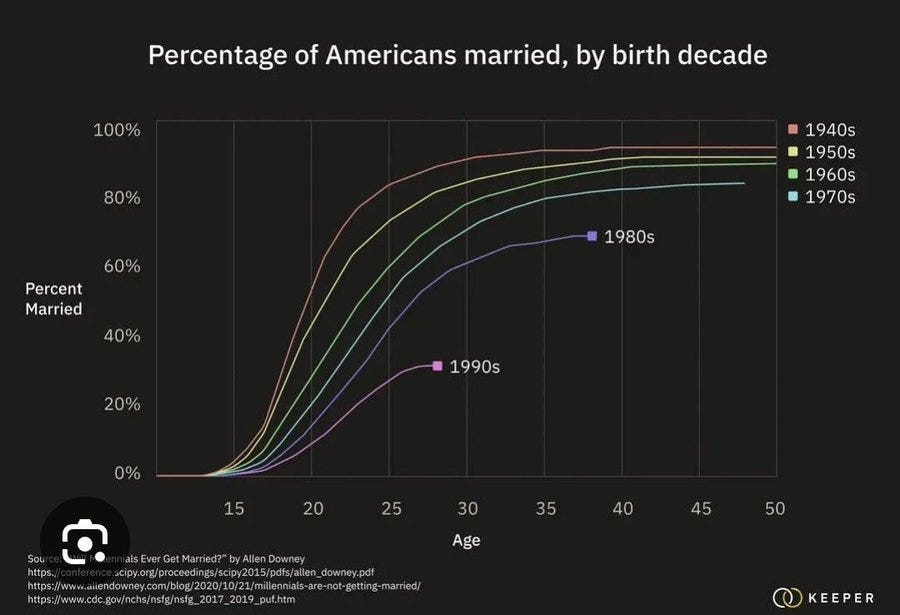
It takes generations to see these effects in full. Not only are we are the product of millennia of selection for marriageability, but social norms are sticky. At first, men see that their fathers worked hard to get married and that their older acquaintances are doing the same, and imitate them. Women aspire to marry as their mothers did. Even when the law has changed, the norms remain. But they get weaker every generation. People see that marriage no longer offers stability, they see their peers and parents ruined in divorce, they see that they can get the former economic and sexual benefits of marriage without taking that risk or giving up options, and the old norms erode.

But let’s say that despite the hurdles you’ve found yourself a stable marriage with someone sensible enough not to blow it up for minor problems, and you’re even confident your own children will do the same. Why care?
Work
“For the young men, that were most able and fit for labour and service, did repine that they should spend their time and strength to work for other men’s wives and children without any recompense.” - Governor William Bradford on the failure of the Pilgrim’s experiment in communal agriculture.
It’s common knowledge that married men earn more money than single men or women.

It’s sometimes claimed that these higher earnings come from men who get married being intrinsically more productive (intelligent, conscientious, capable of cooperation without being pushovers, and so on), and not from marriage itself making men more productive. This is partly true, but only explains a small part of the gap; comparing cross-sectional to fixed-effects results shows that “selection on the basis of fixed unobservable characteristics accounts for less than twenty percent of the observed wage premium” (Korenman and Neumark 1991).
This is usually referred to as the “marriage premium” in the literature, but this is bad framing. Married men are not being gifted more money by competitive companies and there is no extra-market force such as affirmative action to benefit them. Husbands earn more because they are more productive. The prime beneficiaries of this are not the husbands, but their wives, their children, and society at large.

The post-60s settlement attempts to force men to transfer resources to women via the welfare state and child support. But as the Soviets discovered, it’s very difficult to get men to work to the best of their abilities with coercion alone.
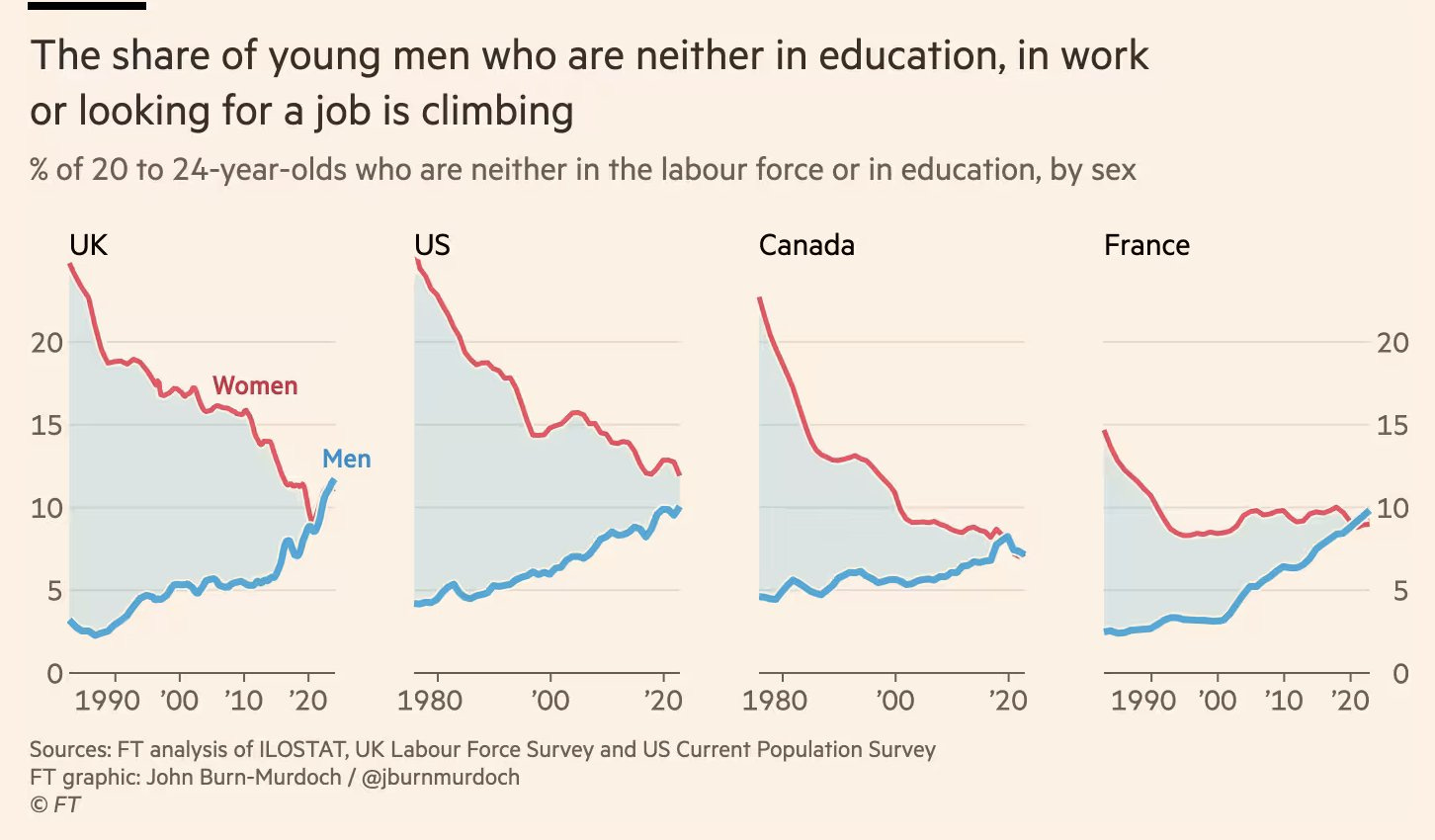
Without marriage, the state loses its taxpayers and society loses the men who make it work.
Crime
Rather than withhold their best efforts from a society that offers them little, men also have the option to actively attack it through crime. Crime can be thought of as a desperate, high-variance reproductive strategy. One might then expect that single men with much (genetically) to gain and little to lose would be more criminal—and this is correct. Within-individual (meaning this is not just a selection effect) studies using Finland population registry data show that married or long-term cohabiting men are between 25% and 50% less likely to commit various sorts of crimes than their single counterparts.

Social conservatives are wrong that broken families make children more criminal. But they are right that marriage reduces crime.
Fertility
People are beginning to notice that the world as a whole is slipping below replacement fertility and that the main centers of civilization have already been there for generations—and are correctly concerned by this. Aged societies are weaker in war, less innovative in peace, and look to the past rather than future. By providing a framework to solve the parenting problem, marriage greatly boosts fertility, even today. This is true across the world, even in countries where an outright majority of births are outside of wedlock.
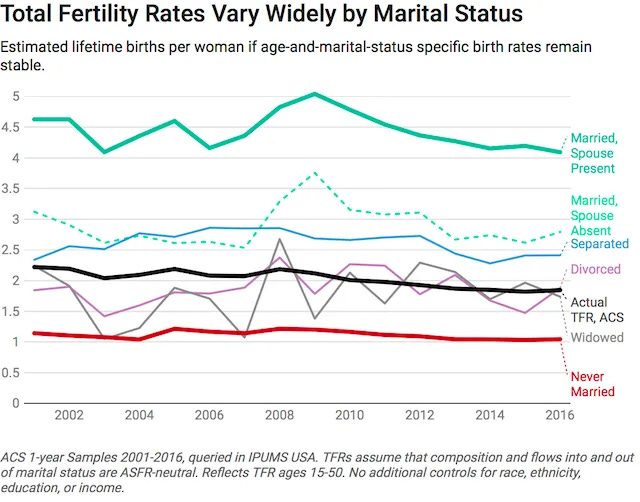
It’s not surprising that the attempted shift from a cooperate/cooperate marriage system to a cooperate/defect one and attendant devastation of the institution corresponds precisely to the end of the Baby Boom.
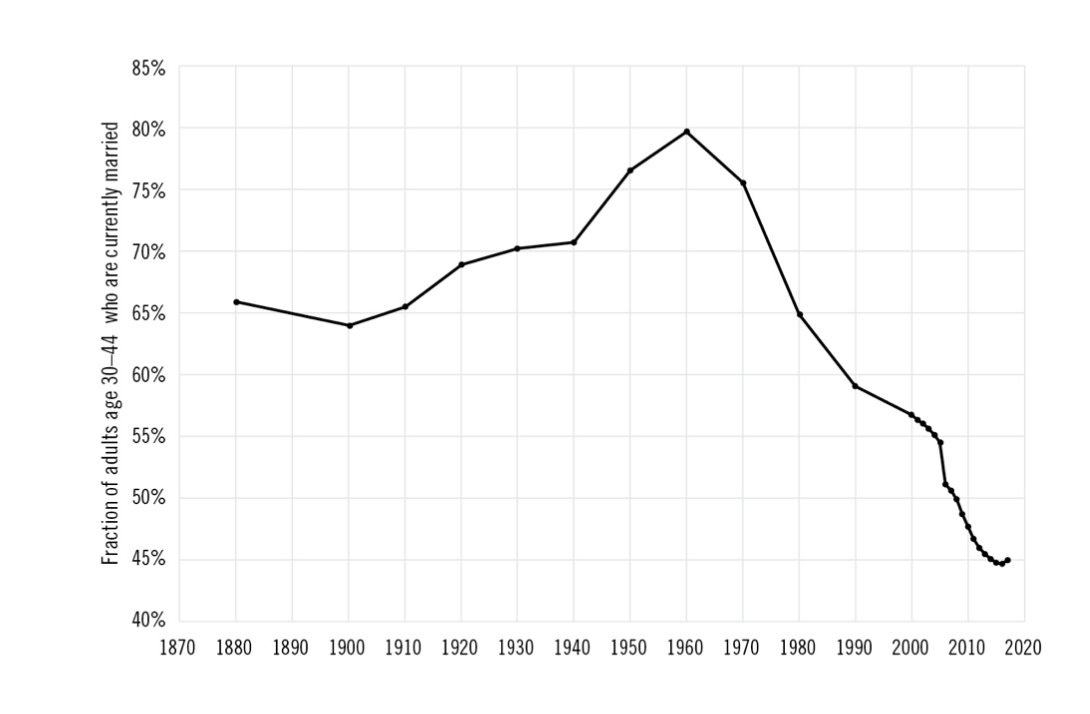
The most important thing marriage does is ensure society’s continuance, which matters to everyone.
Happiness
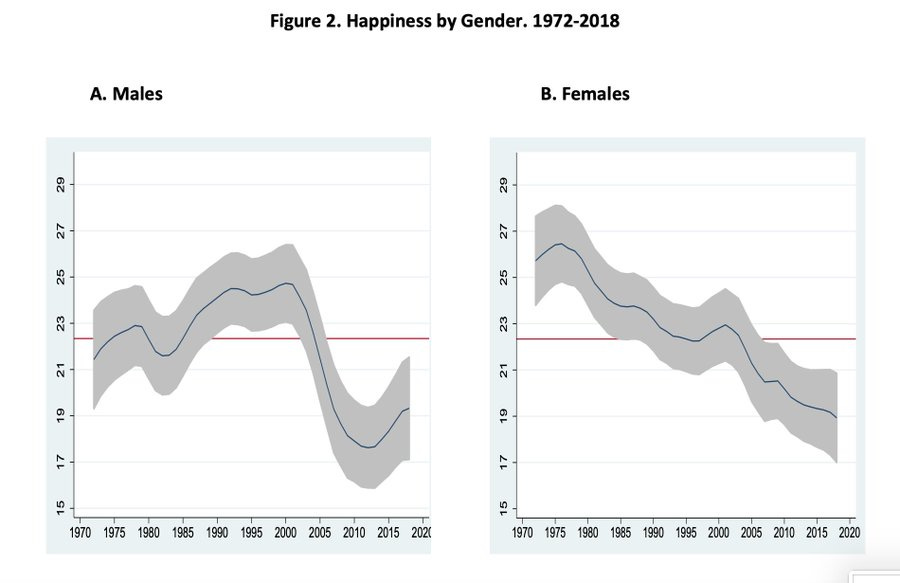
One might hope to justify all of these changes by appealing to happiness. Take no-fault divorce. It’s not hard to find pre-no-fault-divorce horror stories8 and it’s easy to sympathize with the misery of being stuck with someone you hate but don’t have legal grounds to leave. Surely, then, with miserable marriages evaporating like dew, those that remain must be happier, and the remainder, while still worse off than they would have been with a happy marriage, are better off single than miserable? Ex ante, this is reasonable. In practice, however, not only are there fewer marriages and far fewer stable marriages, but those that remain are less happy, not more.

Naively, you would expect the opposite. Less happy marriages are ended more easily, and since there’s fewer marriages formed, one might suppose that unhappy marriages are also differentially less likely to come into existence. What’s happening here? Notice that the big drop in the chart above is from 1970 to 1985. This corresponds to the immediate spike in divorces post-unilateral and no-fault divorce.
Relationship problems that seem insurmountable in the moment often disappear with time, and sheer determination to stick it out can smooth over a lot. But unilateral divorce gives an easy way out, which allows people to fixate on issues that might be resolvable, making even surviving marriages less pleasant.
Where We’re Headed
The attempted second-wave feminist shift from a cooperate/cooperate marriage system, where both men and women sacrifice some of their interests to gain the security required for childbearing, to a cooperate/defect one, where men are expected to uphold their end of the bargain in exchange for nothing, has failed. Men are dropping out or burning things down, and both marriage and children are increasingly relics of the past. In short, we are moving towards a defect/defect society of the sort I briefly sketched out earlier. Men continue to drop out of the labor force and increasingly disdain the grind (bewildering public intellectuals, who fail to understand why men won’t respond to market signals), birth rates continue to decline, and things slowly fall apart. In the event of war, few feel the urge to defend their country. We are in the early stages of the same sort of centuries-long collapse that many civilizations throughout history have suffered.
I am not saying this will happen. If OpenAI cracks superintelligence in five years, neither marriage nor any other current aspect of human life will remain relevant for much longer (one way or another). And forecasting social change ahead of time is infamously difficult; we could draw back from the abyss. But, if human beings remain the subjects of history, and we do not change course, this is where we’re headed. Africa awaits.
Appendix: Marriage vs Cohabitation
Modern marriage is effectively indistinguishable from cohabitation. The term survives out of cultural inertia, but doesn’t actually mean much; this can make cross-country comparisons of things such as births out of wedlock or marriage as measure of union formation misleading because the ratio of marriage to cohabitation varies by country. I use the term “marriage” for post-70s marriage because I am American and the United States still has strong formal marriage norms for the middle class (see Charles Murray’s Coming Apart) and because formal marriage statistics are much more comprehensive and reliable than informal cohabitation statistics. However, if you sum up marriage and long-term cohabitation, you will find the same trends apply even in countries where formal marriage norms have nearly disappeared. For instance, in Finland, first cohabitation has been slowly dropping since the 70s, while first formal marriage has collapsed. Combined, the same decline as in US marriage is evident.
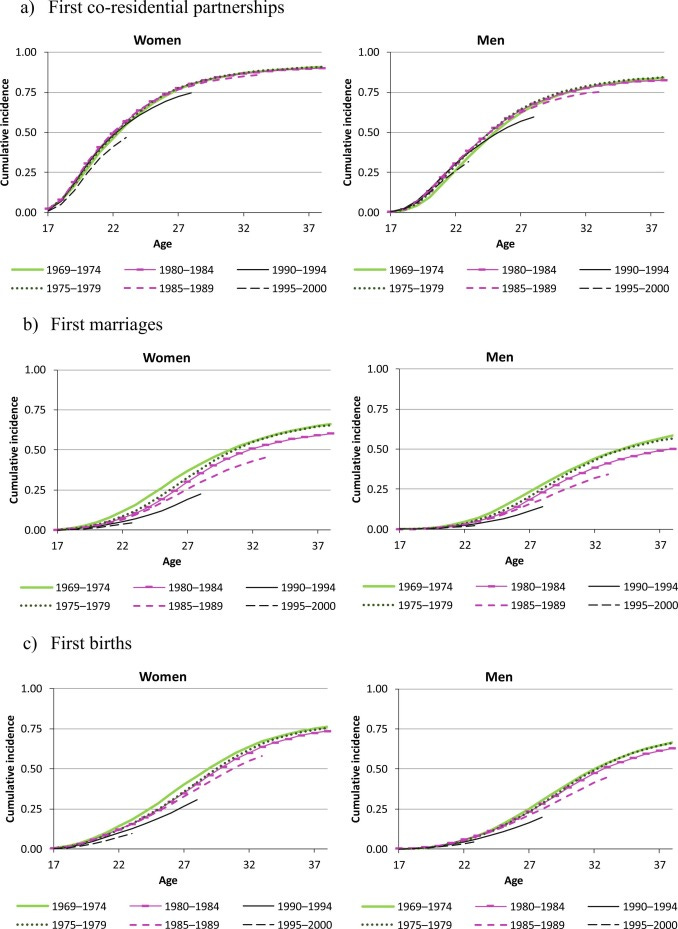
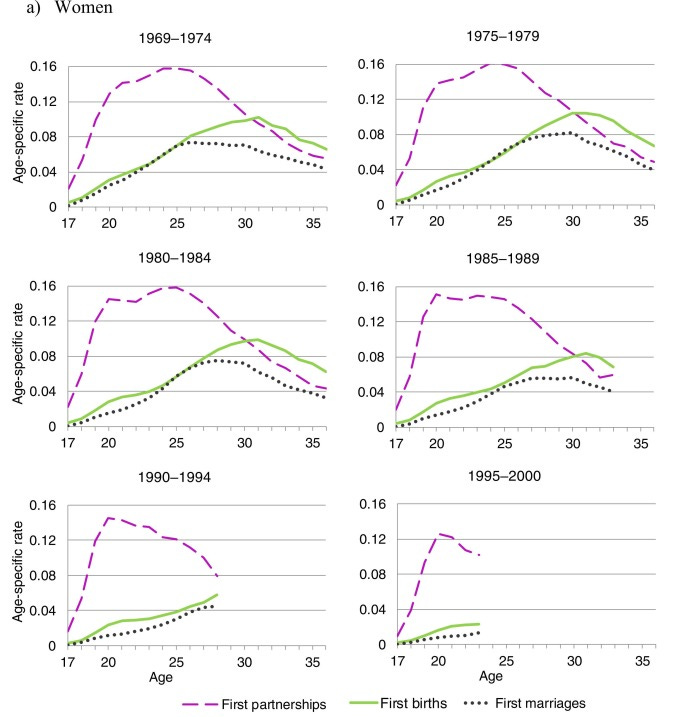
And even in Finland, where 48% of children are born outside of wedlock, couples still prefer to wait until their relationship approximates the stability afforded by marriage to have children. That’s why the timing of births in Finland closely approximates the timing of marriage rather than the timing of first partnership.
The same applies in Sweden, where cohabitation has only fallen slightly, but formal marriage has declined significantly (meaning the combined measure has fallen), and fertility decline tracks the marriage decline.
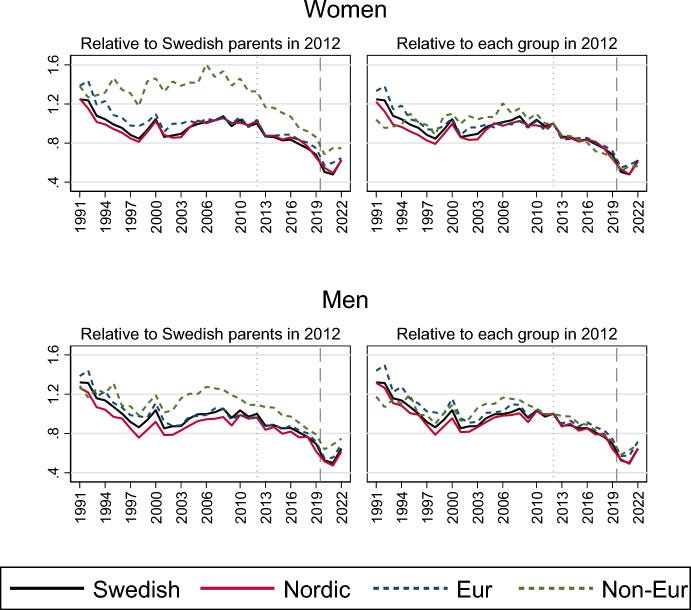
Long-term cohabitation could be substituted for post-70s marriage everywhere in this article and the implications would still be valid. Pre-70s marriage offered legitimacy, social status, and a legal framework for stabilizing cohabitation, post-70s marriage doesn’t. And that’s the problem.
Most forms of marriage also have other benefits, such as reducing sexual conflict by taking some partners off the list of legitimate prospects.
Paternity tests aside. If we’d evolved with them, we’d probably be very different. But we didn’t, and our evolved psychology reflects uncertain paternity.
Economics plays a big role here. In an environment where women cannot support themselves plus their children, such as Ice Age Eurasia or intensive, plow-based agriculture regions like preindustrial Europe or China, this number is often less than one for the average man. In environments where women can support themselves and their children because the population is kept down via disease or warfare, this number can be arbitrarily high.
It should go without saying that “attractive” does not mean “prosocial.” Consider female mallard ducks putting themselves in position to be brutally raped, because rapist male offspring are more reproductively successful.
Joseph Henrich on monogamy as group-selected cultural practice. Monogamy vs polygamy is plausibly the most important divide in marriage, but is largely beyond the scope of this article, since polygamy has never been widespread in the West. See also my Review of Sex and Culture.
There are a bunch of other interesting features and effects of the Western European Marriage Pattern that are not relevant here. See my article on The Western European Marriage Pattern or The Weirdest People in the World.
As opposed to between the parents or clans as in many societies, or theft in the case of groups that acquire wives via bridenapping, slavery, or conquest.
Think private investigators hired to tail spouses to look for innocuous behavior that might be spun as fault before a sympathetic judge.
After thinking about this further, I've realized that there's multiple problems with the reasoning in this article, so I removed it from my homepage. Blithering Genius of Expanding Rationality (https://expandingrationality.substack.com/) helped me write this response.
First, any statistic on marriage isn't very informative, since it confuses the legal institution with pair-bonded relationships. The legal definition has changed over time, and become increasingly irrelevant. Even if it's difficult to find stats on the breakdown of the male-female pair bond, it should be noted in the essay that marriages technically aren't necessary to have or raise children, even if they can be beneficial.
Second, the sexual prisoner's dilemma is between *individuals*, not all males vs all females. Let's consider this quote by Arctotherium: "A defect/cooperate society, in which men act to secure the collective interests of their sex without regard for those of women, looks like Meiji Japan (which was monogamous) or early 20th century Arabia (which was polygamous)."
Society isn't based on the "collective interests" of one sex in opposition to the other. The sexes don't have separate interests as collectives. It would be more accurate to say that a person's sex determines the *individual* interests that they have. If anyone disagrees, then they should point out what these "collective interests" are and how they're "collective".
A society can make it easier or harder to arrange cooperation. A society can't create a defect/cooperate scenario. That doesn't make sense. A society could make it easier for one side to defect, but that would have effect of the deal being harder to arrange.
Third, a male defecting from a female means that he abandons her and her offspring, rather than providing protection and support. Given that this doesn't happen in "defect/cooperate societies", the wording for identifying such societies is misleading. It seems that "defect/cooperate society" was intended to simply mean a society where it's easier for men to divorce their wives on male-favorable terms, if they want to (i.e. the male can keep the children, all the wealth, etc). But even in the event of a divorce, it wouldn't be adaptive for males to raise the children by themselves if they could have the wife do that instead (for free). So it's not clear how that "defect/cooperate society" is a meaningful distinction, from a purely biological perspective.
Fourth, we should be skeptical that the so-called modern cooperate/defect society scenario is a valid categorization as well. It's true that the dynamics of mating, marriage, and divorce are biased towards women's preferences these days. However, this ignores how a historically significant chunk of society is just incels and virgins. A minority of men are getting a lot of sex and love, while many men remain sexless and loveless. It's not clear how or why an abnormally high population of incels and femcels should be labeled "cooperation" or "defection". It just doesn't make sense to extrapolate labels from individual scenarios onto societies.
Fifth, there are also many people who have successful relationships but choose to have no offspring at all. Even if people can manage to have cooperative romantic and sexual relationships, reproduction is not guaranteed. So, the sexual prisoner's dilemma is not sufficient for understanding fertility rates, as the article title implies.
There's simply no predictive or explanatory power to be gained by shoehorning the individual sexual prisoner's dilemma onto society. It also entails multiple false equivocation fallacies. In general, things tend to balance out in most societies, because you can't really have a power imbalance between men and women. Each needs the other. A society can make the pair bond easier or harder to achieve, but it can't create a defect/cooperate situation between the sexes. That's a possible individual outcome, not a collective outcome.
Another banger by the based bear.
This is a sensible summary of your views, with convincing arguments. There's something I'm not sure about.
It is my understanding that, in late Roman empire, mariage had become a bad choice for both parties, especially for women, who then massively became christians as it expected stronger commitments from men. The Collins couple talk about this, commenting a Scott Alexander article as I recall. And nowadays I don't see how the current situation is beneficial to the average woman either, as there's no expected commitment from men. It seems like a downward spiral for both parties to be fair. It mostly benefits to very promiscuous women and very promiscuous men, not to the average male or the average female.
Much to ponder, great work as always!